Do not Lie While Buying/Renewing/Claiming Car Insurance
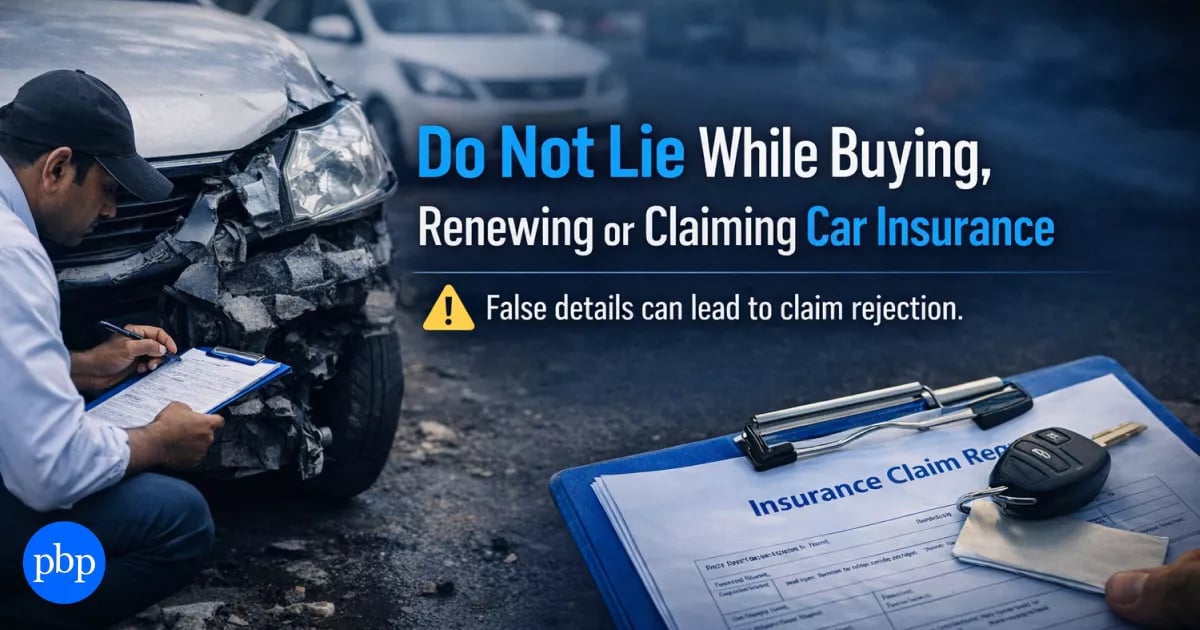
Maintaining transparency with your motor insurer is the most effective way to ensure your financial safety. While some motorists might feel tempted to misrepresent facts to lower their premiums, the long-term consequences of such actions are severe. Car insurance is a legal contract based on the principle of "Utmost Good Faith," meaning both you and the insurer must be completely honest with each other.
In India, providing false information during the purchase, renewal, or claim process can lead to the total rejection of your request and even legal trouble.
The Danger of Misrepresentation During Purchase
When you first buy a policy, the insurer calculates your premium based on several risk factors. Lying about these details might save you a few hundred rupees today, but it puts your entire coverage at risk.
Common Lies at the Purchase Stage
Incorrect Address: Using a small-town address while living in a metropolitan city to get lower rates.
Purpose of Use: Claiming a car is for personal use when it is actually being used as a commercial taxi or for business deliveries.
Driver Details: Not mentioning that a young, inexperienced driver will be the primary user of the vehicle. If you provide the wrong city or usage details, the insurer can declare the policy "null and void." This means if an accident occurs, you will have to pay for all repairs and third-party damages yourself.
Honesty During Policy Renewal
Renewal is the time to update your insurer about any changes that occurred during the previous year. Many people avoid mentioning modifications or small accidents to keep their costs low.
The No Claim Bonus (NCB) Trap
One of the most frequent areas of dishonesty is the No Claim Bonus. NCB is a discount given for every year you do not make a claim. If you switch insurers and lie about having a clean record to get a higher NCB discount, the new company will eventually verify this with your previous insurer.
Calculation Example: The Cost of an NCB Lie

Suppose your premium is ₹20,000. You claim a 50% NCB (₹10,000 discount) despite having made a claim last year.
Scenario: You have an accident and file a claim for ₹1,50,000.
Verification: The insurer finds your NCB declaration was false.
Penalty: The insurer can reject the claim entirely or reduce the payout significantly, often by the same percentage as the wrongful discount. You could lose ₹75,000 or more because of a ₹10,000 lie.
Fraudulent Claims: A Serious Offence
Claiming insurance for damage that didn't happen, or inflating the cost of repairs, is considered insurance fraud. This is the stage where dishonesty carries the highest risk of legal action.
Types of Claim Fraud
Staged Accidents: Intentionally damaging the car to get a new paint job or part replacement.
Prior Damage: Including old dents and scratches in a new accident claim.
Driver Swapping: Claiming a licensed person was driving during a crash when the actual driver was unlicensed or intoxicated.
Insurance companies employ professional investigators and "Loss Assessors" who can easily spot inconsistencies between the damage on the car and your story. If caught, your name could be added to a "blacklist," making it nearly impossible for you to get insurance from any company in the future.
The Impact of Vehicle Modifications
If you add a high-end music system, a CNG kit, or performance-enhancing parts to your car, you must inform your insurer. While these additions increase the car's value or risk, keeping them hidden counts as withholding material information.
| Modifications | Impact on Insurance | Risk of Hiding |
| CNG/LPG Kit | Increases the premium due to fire risk | Fire claims rejection |
| Electrical Fittings | Slight increase for accessories | Short-circuit claims won't be paid |
| Performance Tuning | Significant premium hike | The entire policy could be cancelled |
Final Word
The goal of car insurance is to protect you from unpredictable financial losses. By being truthful during the application and claim stages, you ensure that the safety net you paid for is actually there when you need it. Honesty is not just the best policy; in the world of insurance, it is the only way to stay protected.
Disclaimer* :- The information provided here is for general awareness only. It does not constitute professional advice. While care has been taken to ensure accuracy, readers are advised to consult a qualified professional before making any decisions.





Comments (0)
Leave a Comment
No comments yet. Be the first to comment!